AI Is Deeply Scary. But Christian Radio May Have The Antidote
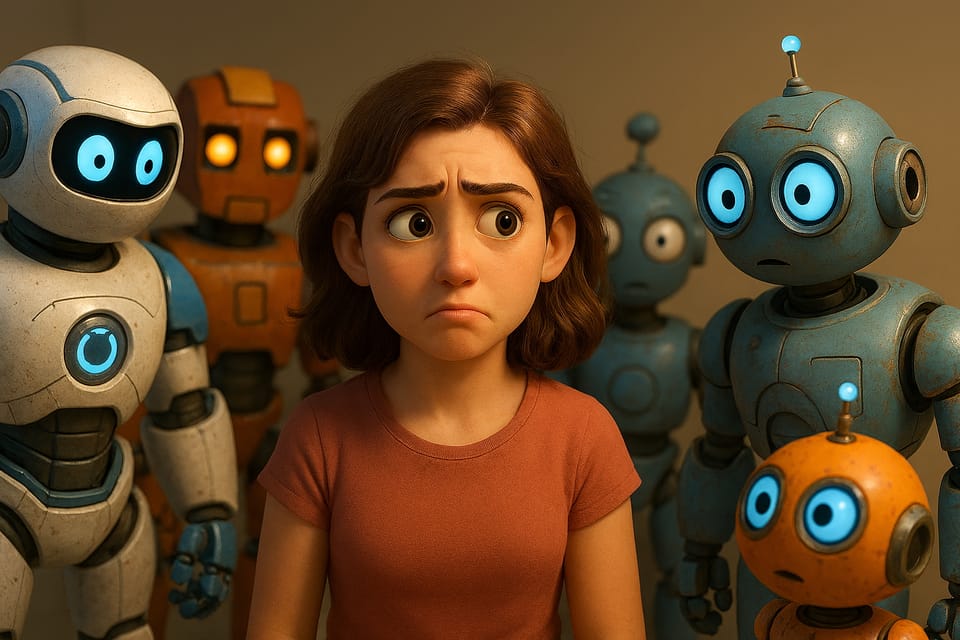
Have you used AI to make your professional or personal life a bit easier or more effective? I'll bet you have. But to consider AI "just another tool" for society is like handing matches to a child and saying "go play!"
The CEO of Anthropic, Dario Amodei, just issued a 38-page essay that warns of "real danger" that superhuman intelligence will cause civilization-level damage absent smart, speedy intervention.
Amodei writes:
I...think that AI will disrupt 50% of entry-level white-collar jobs over 1–5 years, [and] we may have AI that is more capable than everyone in only 1–2 years. Humanity needs to wake up.
In another piece, content marketing guru Joe Pulizzi discusses what he calls the "most dangerous side effect" of AI.
He referenced Viktor Frankl's classic book Man's Search for Meaning (a must-read if you haven't already). Frankl, a survivor of holocaust concentration camps, argued that even in the most extreme human conditions, people can survive extraordinary suffering if they believe their lives still have meaning. And meaning comes from feeling like we matter, that we are needed, and that our presence makes a difference to someone else.
Meaning, Frankl discovered, is not primarily rooted in happiness, comfort, or even professional success. The meanings that sustain people most deeply are almost always chosen in the direction of responsibility for others.
Pulizzi writes:
One of the most powerful examples Frankl gives involves people who fell into deep depression after losing their jobs. At first, it appeared that the loss of income or professional identity was the cause. But when these individuals were placed in volunteer roles, helping in hospitals or community organizations, their despair often lifted.
In other words, it wasn't the job that created the meaning, it was being known and useful to others - being needed - that created meaning.
Being known or needed alone is not enough. If you are known but not needed you are entertainment. And if you are needed but not known you are simply a tool that nobody knows about. Meaning, says Pulizzi, comes from being known and being needed together.
But here's the thing...
If AI is to rampage through the job market eliminating 50% of everything (including tons of radio jobs) and lots of people derive meaning from their work, what are they left with? When machines do our work, what happens when fewer and fewer people actually need us?
"In a world where machines can scale output and automate efficiency," says Pulizzi, "the scarcest asset becomes human relationship."
Being necessary to each other makes life worth living.
Some reality:
- 72 percent of teenagers have used AI companions, and more than half are regular users.
- More than 20 percent of adults aged 18 to 29 report no sexual activity in the past year, a record high
- Over one quarter of forty-year-olds in the United States have never married, another record high (Common Sense Media, Institute for Family Studies).
- Fertility has fallen to a point where deaths will outnumber births by 2038 if trends continue.
- US Teenagers spend about five hours a day on social media
- In 2022, 85 million Americans reported that they did not attend any religious service, nearly double the number from 2008 (US Census Bureau).
For much of our history, work, family, church, and community were the primary delivery systems for meaning. To quote angel Clarence in It's A Wonderful Life, "Each man's life touches so many other lives."
People noticed us. They depended on us. We needed each other. Today, all of these structures are weakening as digital and synthetic AI systems are expanding.
Pulizzi writes:
I think one of the key reasons my wife and I attended the same church for a very long time was that we were absolutely noticed by the same group of people. We got to shake their hands, say hi, and smile. When our kids were younger, they would hold our children when we went up for communion or served at Mass. Of course, the ritual and faith played a role, but the people seemed to be the most important part.
People seemed to be the most important part.
So where are those people?
They are in your local community.
They are on the other side of the speaker or the earbuds.
But they are also in their homes and on the sidewalks and in the malls and on the trails and on the beach and at the lakes and in the mountains. They are in the real world.
And who better to resurrect a sense of community than a faith-based brand devoted to that community?
So how can you be known, needed, and a builder of community?
By putting your current and future fans first. Not just the listeners to your radio station, but your current and future fans.
And that means you need to ask: What will create fans for us in the future, especially in the real world of our community?
And the answer is: Something that helps build that community, helps people feel needed, helps people help each other, helps people feel valued.
And if that sounds like it's more than a radio station, that's because it is. Indeed, it sounds more like a church, doesn't it?
So ask yourself this:
"What products, services, and experiences can our brand provide that are on-mission and help connect people with each other in ways that will make them feel needed and valued in the real world? What can we do to help people help each other to create meaning in their lives?"
This should be the brainstorm du jour at every Christian radio station.
It's why we watch It's a Wonderful Life every single year.
It's why I have been arguing that what folks out there need isn't simply a Christian radio station - it's a Christian media ministry.
And it's not just about making radio. It's about making meaning.
Mark Ramsey Media does audience research for Christian Media - Perceptual research, digital studies, donor studies, underwriter impact studies, music studies, etc. Learn more here. Call Mark at 858-414-4191 or email markramsey@mac.com.
And if you want a strategy to solicit major donors to pay for your research, look here and download this Listener Impact Study solicitation for donors from WAKW-FM.
Want to sign up for this newsletter? Do that here.


Member discussion